Presenting ‘The 3Rs in Zebrafish Research’ at The European Zebrafish Husbandry Association meeting in Gödöllő, Hungary
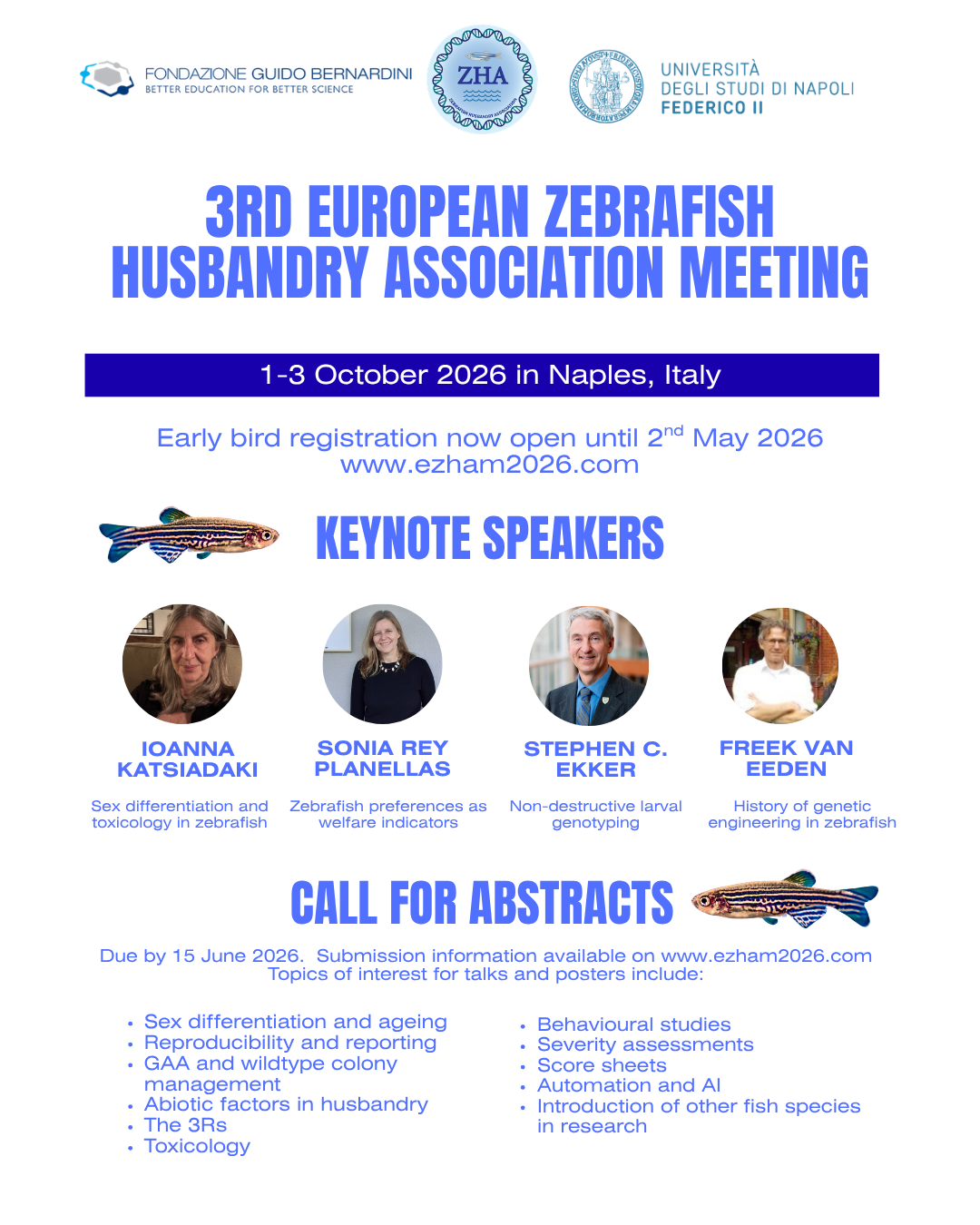
In October 2024, I travelled to Gödöllő in Hungary for the second European Zebrafish Husbandry Association meeting (EZHAM); the first having taken place in London two years earlier. I had been invited to give a talk opening the 3Rs session, as the meeting coincided with the recently published book ‘Zebrafish: A Practical Guide to Husbandry, Welfare, and Research Methodology’, edited by Dr Claire Allen and Dr J-P Mocho. In this book, I had authored a chapter entitled ‘The 3Rs in Zebrafish Research’ and it was this topic I would be giving my talk on.
I’m a neuroscientist and dementia researcher, with a strong interest in bioethics, specifically the ethical use of animals in scientific research. I’m a senior lecturer at Teesside University in the UK, but I previously worked for the NC3Rs, a UK-based organisation that funds research and leads initiatives to promote and implement the 3Rs in scientific research. For those who may not be aware, the 3Rs (Replacement, Reduction, Refinement) are an important ethical and legislative framework for the use of animals in scientific research. In research where zebrafish are used as a model organism, replacement may involve using mathematical or computer modelling as a complete replacement of the use of zebrafish, or alternatively using embryonic or foetal forms of zebrafish as partial replacement. Reduction refers to using the most appropriate number of zebrafish required to obtain statistically meaningful results and using methods and techniques to minimise the use of zebrafish where possible. Finally, refinements in zebrafish research involve any method or approach which can improve welfare or reduce potential harm to zebrafish. In my role with the NC3Rs, I worked with researchers and animal facility staff across several universities to share best practice, as well as being a member of several ethics committees where I advised on the 3Rs in animal-based projects.
Presenting at EZHAM provided me with an opportunity to inform delegates about advancing the 3Rs in zebrafish research, and share current research on zebrafish welfare, including husbandry methods and techniques. Gödöllő is situated about 20 miles northeast from Budapest, the capital city of Hungary. To keep financial costs down, I decided to stay in a hotel I’d been in before on a previous trip to Budapest and get the short train ride to and from Gödöllő on the days of the meeting.
The station in Gödöllő was located at the bottom of a small hill, with the venue a short walk to the top. I always feel that the best way to get a sense of a new place is by using public transport, and I thoroughly enjoyed travelling on the local trains with the commuters.
The meeting was hosted at the Institute of Aquaculture and Environmental Safety of the Hungarian University of Agriculture and Life Sciences. The specific venue was the Agricultural Machinery and Technology Curiosity Museum, which housed many fascinating exhibitions on historical use of machinery and equipment, which we could explore during the breaks.
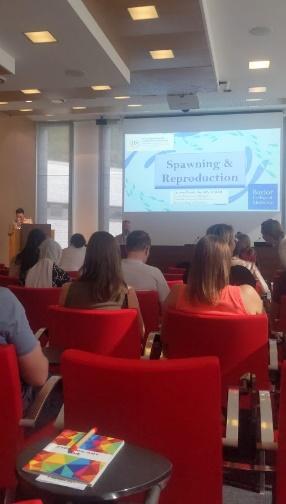
When I arrived, I registered and took a wander around the exhibitors which were interspersed among the museum items. The posters were in a separate room adjacent to the large seminar room where the talks would be held. The meeting was extremely well organised, and it was clear that a lot of thought had gone into the best way to host a hybrid meeting and deliver a positive experience for online delegates. Professional cameras and recording equipment were set up, with around four or five dedicated technical staff responsible for this side of things. This meant I could give them my presentation slides without worrying about any IT issues, which is always the most stressful part of giving a talk! Having the meeting recorded also meant myself and other delegates could go back and watch any talks we enjoyed or may have missed.
Before I discuss my 3Rs talk, I want to share some of my personal highlights from the meeting. Of the posters, there were two that particularly appealed to my interests. The first was by Lisa Van Hateren from the University of Sheffield, UK. The poster evaluated methods of genotyping zebrafish and how procedure numbers can be reduced by genotyping embryos or using methods which are more refined than the commonly used fin clipping of zebrafish adults. Secondly, Anita Rácz from the University of Glasgow, UK, presented some interesting data on refining commonly used visible implant elastomer identification tags, with potential welfare benefits. There were some fantastic talks throughout the meeting, including two by Professor Lynne Sneddon from the University of Gothenburg, Sweden. I’ve seen Professor Sneddon give talks on a number of occasions and it’s always a pleasure to hear her present her research which has truly advanced zebrafish welfare, and our understanding of this species as it has gained popularity as a model organism. Professor Sneddon shared her work on environmental enrichment, as well as methods to assess zebrafish welfare, recognising pain, and pain management protocols.
A talk by Dr Christian Lawrence from SmartLabs, USA, generated interesting discussions on a topic which is applicable across many areas of laboratory science, not just zebrafish research. Protocols and environmental conditions can vary greatly across labs and institutions, but should we be striving for greater standardisation? Human diseases and conditions can have significant variation in how they present, which can be attributable to heterogenous genetic and environmental factors. Perhaps greater translation between animal and human studies can be achieved by simply improving the reporting of any differences in laboratory studies rather than
trying to achieve standardisation. Finally, a talk by Dr Gregory Paull from the University of Exeter, UK, presented an interesting discussion on the UK Home Office Breeding and Maintenance protocol for genetically modified zebrafish. This stipulates that zebrafish are to be kept only to a maximum of 18 months of age, after which they are required to be euthanised. Dr Paull highlighted the lack of data on whether this is consistent with the 3Rs and maintaining welfare standards if the zebrafish are healthy at 18 months of age and continuing to breed successfully. Moreover, this policy could be leading to more zebrafish being used for breeding and maintenance than is necessary.
As I previously said, my talk opened the 3Rs session on Day 2. I used this opportunity to update delegates on contemporary definitions of the 3Rs and share resources and guidelines to assist with the design and reporting of scientific experimental studies that involve the use of zebrafish. I discussed how better reporting, more reproducible studies, and new methods and technologies contribute towards advancing scientific progress and ensuring the highest standards of welfare are applied. Following Dr Lawrence’s talk, I agreed that there was a lack of standardisation across zebrafish facilities, but I discussed that for improved translation, this shouldn’t necessarily be the goal. Instead, better reporting to ensure studies are reproducible, should be. In addition, following Dr Paull’s talk I agreed that more research was needed to determine the validity of not maintaining breeding zebrafish after 18 months of age. In my talk I discussed how if zebrafish are still healthy and breeding beyond 18 months of age, this would go against the 3Rs principle of reduction, as it would lead to more zebrafish being required for breeding. However, if maintaining the zebrafish for breeding beyond this age had a negative
impact on experimental outcomes, e.g., by affecting the quality of offspring, then this would go against reduction because more zebrafish would be required to minimise variation, and there could potentially be an increase in attrition rates. It would also go against refinement, if the breeding zebrafish experienced any negative health implications from breeding beyond 18 months of age. Finally, best practice in zebrafish husbandry techniques is direct refinement, so this was an opportunity to share knowledge within the community.
Research on zebrafish welfare is advancing quickly so EZHAM was an important opportunity for the zebrafish husbandry community to be kept up to date on best practice, particularly on evidence that has implications for the 3Rs. It was great to hear about recent advances in zebrafish husbandry and research and establish areas where more work is needed. I want to thank the Zebrafish Husbandry Association for awarding me the Advancement Fund, without which I wouldn’t have been able to attend the meeting.